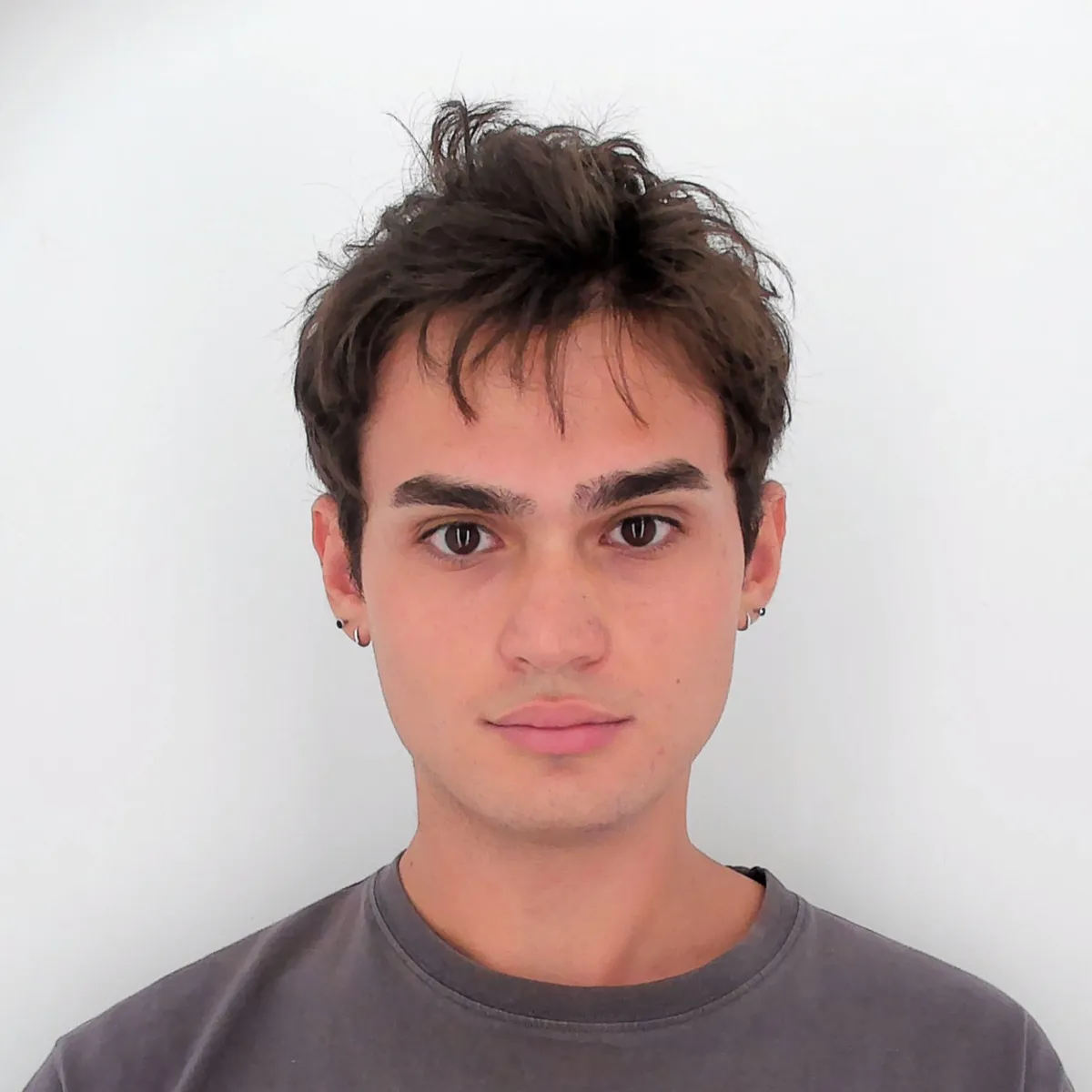
Emanuel Gordis
San Francisco, CA
About
I grew up in Berkeley, CA and was homeschooled. I build models that learn to simulate complex physical systems faster than classical methods allow.
Most recently, I founded Trim (YC W25), where I studied how different sequence-modeling approaches behave on physical systems. I developed a transformer-based physics world model using a custom attention mechanism, resulting in a 97% reduction in memory usage and a 6.5× speedup on Navier-Stokes benchmarks. The trim-transformer package is open source.
Before founding Trim, I conducted astrophysics research at Lawrence Livermore National Laboratory — simulating thermonuclear detonation in Type Ia supernovae — and quantum mechanics research at Princeton with Prof. Michael Littman, studying Rydberg atom quantum states. Both projects resulted in publications. I also built computer vision and ML infra at AWS.
I studied physics at Cornell and spent a formative stretch at Reed College, where I became the youngest federally licensed reactor operator in the United States.
Publications
Stability and Convergence of Nuclear Detonations in White Dwarf Collisions P. Anninos, D. Cruz-Lopez, B. Jiang, E. Gordis · arXiv, 2025
The hydrogen Rydberg atom viewed through the lens of the old quantum theory M. G. Littman, E. Gordis, P. Zhelnin, J. Arnold · American Journal of Physics, 2023
Research
Founder — Trim (YC W25) · 2025–2026
Physics world model with a custom attention architecture. Achieved 97% memory reduction and a 6.5× speedup on Navier-Stokes benchmarks over standard transformers. Open-sourced as trim-transformer, a drop-in replacement for standard PyTorch transformers.
Unified ANIE, backpropagation through time, and video transformers as a 2×2×3 design grid, ablated all 12 configurations across PDE benchmarks including Navier-Stokes, Burgers, and Shallow-Water. Found that distributional shift dominates performance. Shared weights with no block residuals were consistently near-optimal, suggesting an inductive bias toward iterative refinement.
Quantum Mechanics Researcher — Princeton University · 2020–2023
Investigated Rydberg atom quantum states using Bohr–Sommerfeld semi-classical analysis, with Prof. Michael Littman. Published in American Journal of Physics.
High-Energy Physics Researcher — Lawrence Livermore National Laboratory · 2020–2021
Simulated Type Ia supernovae white dwarf collisions, modeling magnetic field effects on thermonuclear detonation propagation. Published in The Astrophysical Journal.
Other Experience
Software Engineer — Amazon Web Services · 2023–2024 Built load balancing infrastructure for ML training queues and led a live production database migration from SQL to DynamoDB with zero downtime.
Reactor Operator — Reed Research Reactor · 2019–2020 Youngest federally licensed reactor operator in the United States.
Education
Cornell University — B.A. Physics, Concentration in Computer Science · 2022